Table of Content
By tracking the following key performance indicators for home health care, you can identify the problems early, and take appropriate measures. To keep your agency's performance at a high level, you need to ensure that the services you’re providing are being delivered according to your client’s personal needs, at the right place, and at the right time. Below you will find four key performance indicators in healthcare that fall into this section, that you might benefit from tracking. In accordance with Government decision to align the introduction of quality indicators with broader home care reforms, work of the consortium has refocused to identify, assess and deliver an operational framework for quality indicators and CEQOL measures in a new in-home aged care program. Our analyses provide evidence of the feasibility, reliability, and validity of proposed survey-based measures to assess the quality of home-based serious illness care from the perspective of patients and their families. Regarding key performance indicators for home health care, they should cover all key areas like overall client satisfaction, on-time client visits, employee retention, reporting, and billing.
You can easily track this KPI by calculating the number of times a caregiver was late, skipped the visit, or did not provide care following the plan. It's important to keep track of this KPI as it shows the quality of service that you provide to your client base. This measure assesses the Medicare spending of a home health agency, compared to the average Medicare spending of home health agencies nationally for the same performance period.
Financial KPIs
The Centers for Medicare & Medicaid's Services reports many of the NQF-endorsed measures on its Home Health Compare website. Some other report developers also present this data, sometimes along with other information about home health care. For a list of home health outcome measures, please refer to the Home Health Outcome Measures Table, which can be located via the link for Home Health Measures Tables in theDownloadssection below. Technical Specifications for calculating OASIS-based outcome measures, patient-related characteristics measures, and the factors used to risk adjust outcome measures, can be accessed via the link for Technical Documentation of OASIS-Based Measures in theDownloadssection below.

To calculate it, divide the number of clients admitted by the total number of people who made an inquiry about your services in the same period. If the client turnover is significant, it might imply poor client satisfaction and the low quality of the service provided. You can calculate it by dividing the number of all active clients during a time period by the number of months care was provided.
Patient consent for publication
This study was a cross-sectional mixed-methods analysis of in-depth multimodal data from 31 POs affiliated with 22 purposefully selected health systems in 4 states. This study offers a provisional framework that can help in structuring thinking, policy and practice. By outlining the range of domains relevant to remote antenatal care, this framework is likely to be of value in guiding policy, practice and research. The objective of this paper is to review evidence on survey administration strategies to improve response rates and representativeness of patient surveys. Exploring how often inquiries turn into admissions will help you answer various questions.

A set of standards can help identify providers who serve veterans and deliver high-quality care. Such analysis can help you determine whether there is anything in the process that makes the prospective clients give up using your agency's services. By tracking KPIs for your primary goals, you will know if your team is reaching home health productivity benchmarks, and you can implement incentives based on their achievements.
Health Care Quality Indicators
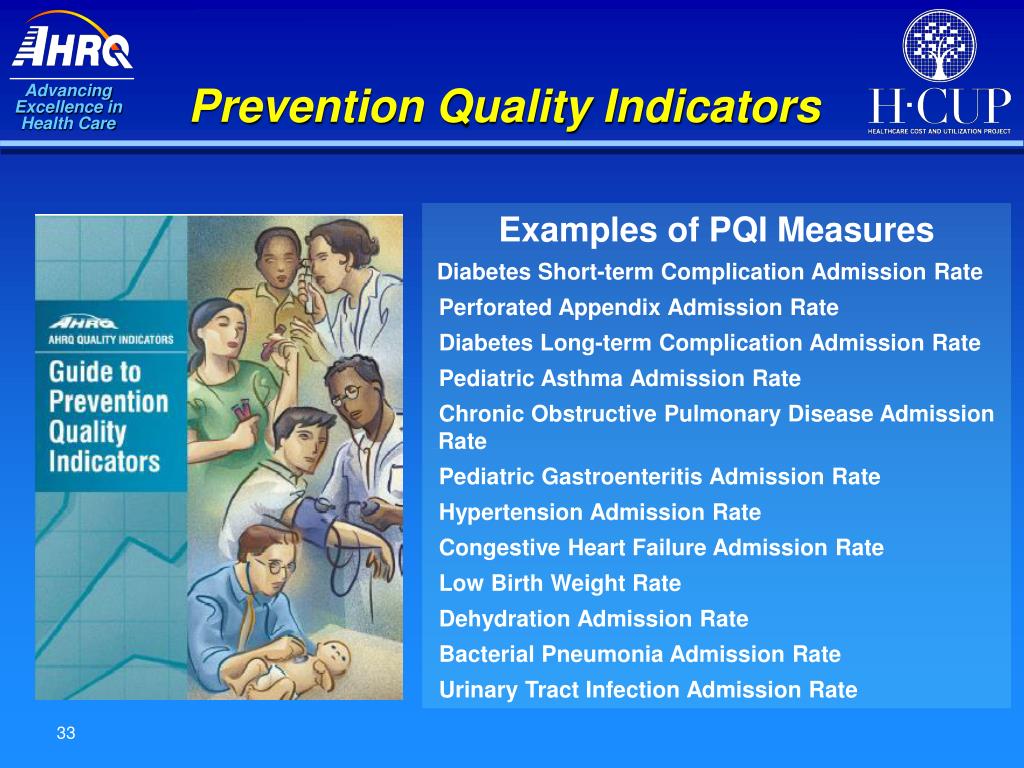
The Health Care Quality and Outcomes programme previous known as Health Care Quality Indicators Project was initiated in 2001. The aim was to develop and report indicators for international comparisons of health care quality. Over the past twenty years, data collection and analysis have been carried out, progressively expanding the coverage of the dimensions within the framework above and the number of countries involved. Prevention Quality Indicators identify "ambulatory care sensitive conditions", which are conditions that can be effectively treated in an outpatient setting, potentially preventing the need for inpatient hospital admissions. PQIs can be used as a "screening tool" to flag potential health care problem areas and provide possible insight in to the sufficiency of primary care access or outpatient services in a community, help public health agencies. That's why it's crucial to pay attention to all the warning signs that may point to their dissatisfaction with their job or that may lead to caregiver burnout.
To ensure fair comparison of serious illness programs, quality measure scores should be case-mix adjusted for variables that influence patients' reports about care quality, but are not under the control of the program administering care. As part of a national effort to develop palliative care quality metrics for use in accountability programs, we sought to develop survey items assessing patients' experiences of outpatient palliative care, incorporating the patient's voice. For the beginning, you can start by following these two marketing key performance indicators for home health care we’ve selected.
Using CAHPS Patient Experience Data for Patient-Centered Medical Home Transformation
The data collected by tracking KPIs provides statistics and enables a home healthcare agency to analyze its progress over a specific time, compare it to its industry peers and look for ways to improve its performance. The National Quality Forum , a multistakeholder organization established to standardize health care quality measurement and reporting, has endorsed several consensus standards for skilled home health services. Process measures evaluate the rate of home health agency use of specific evidence-based processes of care. The HH process measures focus on high-risk, high-volume, problem-prone areas for home health care. These include measures pertaining to all or most home care patients, such as timeliness of home care admission.
HCQA applies these Quality Indicator tools to the New Jersey inpatient discharge data to come up with data that measure healthcare quality. The data help hospital administrators and DOH to identify potential areas of concern that may need further investigation. Increasingly, tools and surveys are employed to determine current and optimal levels of health care service and performance, and ultimately to improve the levels for each. RAND helps policymakers, health care leaders, and practitioners determine cost-effective and accurate ways to measure the quality of health care being provided, and then recommends ways to improve the level of health care quality. KPIs need to address all aspects of a business, from the quality of care and client conversion to HR, marketing, and finance.
The number of quality indicators has proliferated, without a parallel emphasis on understanding the relationships between indicators or their contribution to the overall objective of monitoring one or more aspects of the quality of care. Instead, the number of quality indicators has increasingly become a burden, rather than a useful tool to help us achieve safer and better care. We argue that a focus on the construct being measured and assessing the validity of a set of indicators is needed to achieve that aim. This is a very different approach from simply creating more and more indicators covering every aspect of care and hoping that they will collectively amount to a useful measure of quality. When designing a questionnaire or developing a psychological test, we are careful not to overburden respondents and therefore measure only what matters to assess the underlying construct and meet the objectives of the study or programme.
Percentage of patients reporting that home health providers treated them as gently as possible. The development of measures for home health is in the early stages, but several measures have been endorsed by NQF and are being reported. Here are some examples of measures that would be appropriate for reporting to consumers and are currently included in the Centers for Medicare & Medicaid Services’ (CMS’) Home Health Compare Web site. The Patient Safety Indicators provide information on potential in hospital complications and adverse events following surgeries, procedures, and childbirth. PSIs can be used to help hospitals identify potential adverse events and assess the incidence of adverse events and in hospital complications. On February 7, 2022, the RAND Corporation convened a Technical Expert Panel web meeting to gather input about the potential development of a measure to capture value-based care arrangements Medicare Advantage organizations have with their contracted providers.


No comments:
Post a Comment