Table Of Content
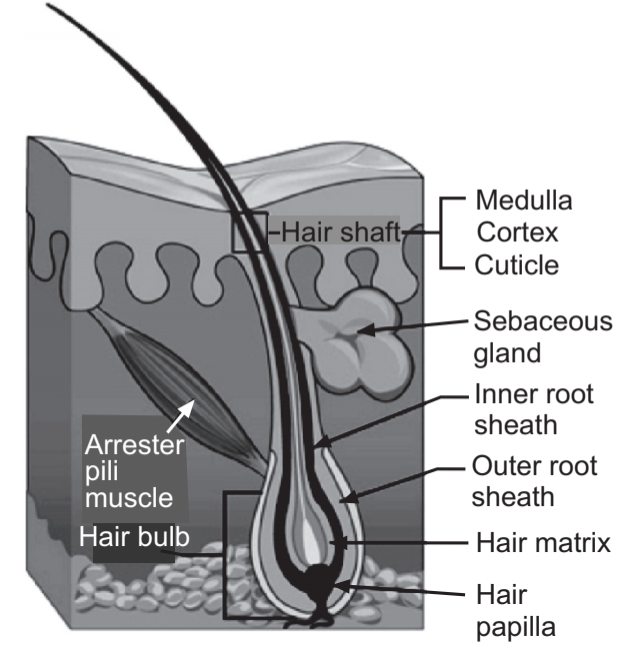
Anagen hairs vary in size from large terminal hairs, such as those on the scalp, to the small vellus hairs that cover almost the entire glabrous skin (except palms and soles). Under hormonal influences, the vellus hair follicles in the male beard area usually thicken and darken at puberty. In predisposed individuals, the terminal hairs on the adult scalp can undergo involutional miniaturization (become vellus). Hair is a protein filament that grows from follicles found in the dermis. Hair is one of the defining characteristics of mammals.The human body, apart from areas of glabrous skin, is covered in follicles which produce thick terminal and fine vellus hair. Most common interest in hair is focused on hair growth, hair types, and hair care, but hair is also an important biomaterial primarily composed of protein, notably alpha-keratin.
Root of the hair
Telogen effluvium is a temporary, but common form of hair loss. The hair follicle is a skin appendage located deep in the dermis of the skin. The cross-sectional shape of hair also determines the amount of shine that the hair has. Straighter hair is shinier because sebum from the sebaceous gland can easily travel down the hair.
The Biology, Structure, and Function of Hair
Whether you dream of opening your own salon, styling celebrities for the red carpet, working in the film industry, or creating beautiful memories for people through hair and makeup, your career in beauty starts here. As one of the leading beauty schools in Orange County, expect to have hands-on training in Cosmetology, Esthetics, or Barbering. Our experienced instructors keep themselves up to date with the latest techniques to ensure they deliver cutting edge training. With our programs ranging from as little as 5-months to 10-months with full-time attendance, students learn the theory, practical skills, and confidence to pass the California State Board Exam and become a licensed professional. The ORS does not keratinize below the level of the isthmus (in contrast to the IRS). However, at the level of the isthmus where the IRS disintegrates, the ORS keratinizes without forming granules (trichilemmal keratinization), which is similar to the keratinization of the hair cortex.
Loose areolar tissue
Lanugo, vellus and terminal hairs follow the same basic architectural principles. The first “coat” that is formed is fine, long, variably pigmented lanugo hair, which is shed in an anterior to posterior wave during last trimester of gestation. A second coat of fine, shorter, unpigmented lanugo hair then grows in all areas except the scalp and is shed 3–4 months after birth.
Anatomy For Sculptors Shared a Useful Hair Growth Reference - 80.lv
Anatomy For Sculptors Shared a Useful Hair Growth Reference.
Posted: Thu, 01 Dec 2022 08:00:00 GMT [source]
Telogen effluvium
It can be due to drugs, diet, hormone imbalances, altered mitotic activity, growth cycle abnormalities, among others. A thorough history, physical exam, hair pull test, daily hair counts, part width, clip tests to examine the hair shaft, hair growth windows, and hair pluck, and trichograms can all be used to diagnose hair disease. Scalp biopsies, hormone studies, and a potassium hydroxide examination for fungi may also need to be performed in certain cases. It is important to diagnose hair disease correctly, as the treatment for hair loss is dependent on the diagnosis. Your hair follicles are responsible for growing hair, which happens in cycles of three distinct phases.
It can take three to five weeks for waxed hair to begin to resurface again. Hair in areas that have been waxed consistently is known to grow back finer and thinner, especially compared to hair that has been shaved with a razor. Depilation is the removal of hair from the surface of the skin. Epilation is the removal of the entire hair strand, including the part of the hair that has not yet left the follicle.

What is a hair follicle made of?
Your follicles can lose their ability to produce melanin as you age, which results in the growth of gray or white hair. According to the American Osteopathic College of Dermatology, the average person loses approximately 100 strands of hair a day. About 90 percent of your hair follicles are in the anagen phase at any given time. Because hairs continue to enter the resting phase and then fall out, we are constantly losing hair. A healthy adult may lose about 70 to 100 hairs on their head per day.
The infundibulum, the uppermost portion of the hair follicle extending from the opening of the sebaceous gland to the surface of the skin, is a funnel-shaped structure filled with sebum, the product of the sebaceous glands. The upper part named acroinfundibulum, the keratinization of epithelium turns into the “epidermal mode”, with formation of stratum granulosum and stratum corneum like a similar manner to epidermis [1, 14, 16]. The histology of your hair can vary slightly depending your ethnicity. When a cross section of a hair is made, its shape differs depending on the characteristics of your hair determined by your race, and the genes you get from your parents. For example, the straight hair of many Asian people gives a perfectly round cross section.
Hair growth cycle
The formation of a club hair, an important prognostic indicator in assessing hair pathology, also occurs at this time. If many hairs form club hair at once and are subsequently shed, it can give the appearance of thinning. Some conditions this may occur in include, but are not limited to, hypothyroidism, hyperthyroidism, stress, vitamin deficiencies, and post-childbirth. The cuticle comprises flat overlapping cells covering the hair shaft from the root until it exits from the epidermis. The cuticle is of considerable cosmetic importance as it gives the hair an untangled appearance and shape. A hair follicle is a tunnel-shaped structure in the epidermis (outer layer) of the skin.
At the level of the infundibulum, keratinization of the ORS changes to normal epidermal keratinization with formation of the granular cell layer and stratum corneum. The basal cell layer of the ORS contains inactive amelanotic melanocytes; in contrast, the surface epidermis that lines the infundibulum contains active pigmented melanocytes. The inactive melanocytes in the basal cell layer can become melanin-producing cells after skin injury (eg, chemical peels, laser resurfacing, dermabrasion). They proliferate and migrate toward the regenerating upper portion of the ORS and the epidermis.
Except for a few growing cells at the base of the root, the hair is dead tissue, composed of keratin and related proteins. The hair follicle is a tubelike pocket of the epidermis that encloses a small section of the dermis at its base. The human hair is formed by divisions of cells at the base of the follicle.
A number of hair conditions are caused by issues with hair follicles. If you think you have a hair condition, or if you have unexplained symptoms like hair loss, it’s best to consult with a dermatologist. The average human has about 100,000 hair follicles on the scalp alone. Richard Webber (James Pickens Jr.), Chief of Surgery and attending general surgeon, is the former lover of Ellis Grey. During the first six seasons, Burke, O'Malley, and Stevens all depart the series. Grey's Anatomy is an American medical drama television series focusing on the personal and professional lives of surgical interns, residents, and attendings at the fictional Seattle Grace Hospital, later named the Grey Sloan Memorial Hospital.
The twelfth season saw Andrew DeLuca join the main cast as a new intern at the hospital, as well as Nathan Riggs as a new cardiothoracic surgeon with a pre-existing off-screen history with Hunt. The season 12 finale saw the departure of one of the show's longest-running characters, Callie Torres, played by Sara Ramirez. Edwards departed at the end of the thirteenth season, deciding to quit her job as a surgeon after surviving a major fire at the hospital.
However, any apoptosis is occurred in dermal papilla due to the expression of suppressor bcl-2 [11]. In contrast to the continuous melanogenesis observed in epidermal melanocytes, follicular melanogenesis is a cyclic phenomenon. It is ceased in early the anagen-catagen transition, restarted with the down-regulation of key enzymes of melanogenesis, followed by hair follicle melanocyte apoptosis. This can occur on the entire scalp (alopecia totalis) or body (alopecia universalis) or may be localized to specific areas (alopecia areata). Alopecia areata can progress to alopecia totalis and often begins acutely and spreads gradually over the course of weeks to months.
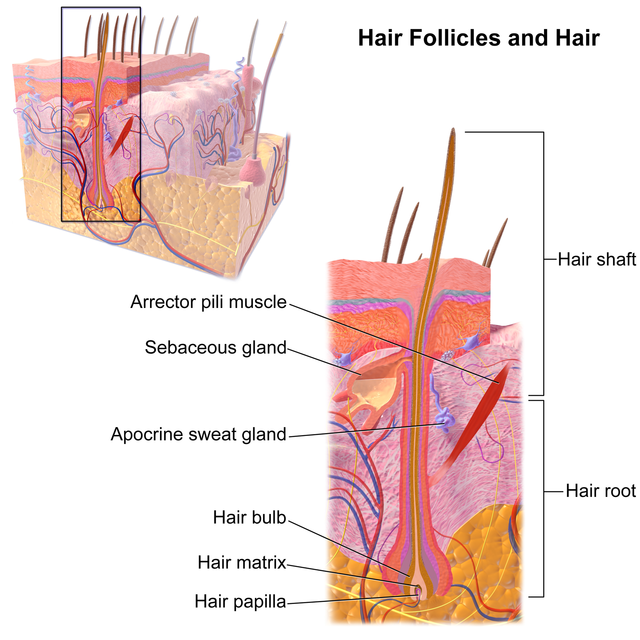
Keratinization is completed as the cells are pushed to the skin surface to form the shaft of hair that is externally visible. The external hair is completely dead and composed entirely of keratin. Furthermore, you can cut your hair or shave without damaging the hair structure because the cut is superficial.
The corresponding acyl chain correlation peaks were observed at Q values of ∼ 1.65 Å−1. The observed differences in the X-ray diffraction patterns between different individuals can, therefore, most likely be assigned to differences in the molecular composition of the plasma membrane in the cell membrane complex. The keratin coils organize into intermediate filaments whose structure and packing in the plane of the hair result in additional scattering signals. The packing of these fibrils by bundling into macro-fibrils is characterized by X-ray diffraction pattern by three equatorial spots located at about 90, 45 and 27 Å (Busson, Engstrom & Doucet, 1999).


No comments:
Post a Comment